Showing posts with label cs education. Show all posts

Monday, July 18, 2011

0 Computational Thinking

This week I am at a computational thinking workshop at Carnegie Mellon University. This workshop is part of their ACTIVATE (Advancing Computing and Technology Interest and Innovation through Teacher Education) workshops for teachers.


Workshop Description (in case your interested for next year)

This workshop illustrates the wide variety of applications of computational thinking at conceptual and practical levels through a series of teacher-participation exercises and presentations. In particular, the workshop includes hands-on activities that teachers can duplicate in their classrooms to illustrate computing principles beyond computer programming. (From the CMU ACTIVATE website)
I am always looking for opportunities to learn new programming languages and applications of computing, which is why I enrolled for this workshop (oh, did I forget to mention, they pay you to attend :) )


What is computational thinking? This term was coined by Jeanette Wing, her vision "is that computational thinking will be a fundamental skill used by everyone in the world by the middle of the 21st century."

Some examples of computational thinking in our everyday lives:

  • Sorting important documents
  • Choosing a line at the supermarket (queuing and scheduling)
  • Putting things in your child's knapsack for the day (caching)
  • Running errands (traveling salesperson)
  • Cooking dinner or washing loads of laundry (parallel processing/pipelining)
Computational Thinking in STEM
  • Biology: DNA sequences are strings in a language
  • Brain Science: Analyzing fMRI data with machine learning algorithms
  • Chemistry: Optimizaion and searching algorithms identify best chemicals for improving reaction conditions to improve yields
  • Engineering: Boeing 777 tested via computer simulation alone, not in a wind tunnel
An operational definition of computational thinking for K-12
  • formulating problems in a way that enables us to use a computer and other tools to solve them
  • logically organizing and analyzing data
  • representing data through abstractions such as models and simulations
  • automating solutions through algorithmic thinking (a series of ordered steps)
  • identifying, analyzing, and implementing possible solutions with the goal of achieving the most efficient and effective combination of steps and resources
  • generalizing and transferring this problem solving process to a wide variety of problems

Friday, March 12, 2010

0 Re-imaging the first year of computing

Principles is the 'new' and proposed AP CS course. The Collegeboard, CSTA and lots of other folks are working to develop this curriculum.I found it interesting that they are piloting the curriculum at colleges/universities PRIOR to pilots at high schools. The rationale is that piloting at colleges/universities will show that this is college level material.

Maybe this can be the start of an agreed upon CS0 course for colleges/universities??

Website - www.csprinciples.org

Big Ideas

  1. Computing is a creative human activity that engenders innovation and promotes exploration.

  2. Abstraction reduces information and detail to focus on concepts relevant to understanding and solving problems.

  3. Data and information facilitate the creation of knowledge.

  4. Algorithms are tools for developing and expressing solutions to computational problems.

  5. Programming is a creative process that produces computational artifacts.

  6. Digital devices, systems, and the networks that interconnect them enable and foster computational approaches to solving problems.

  7. Computing enables innovation in other fields including science, social science, humanities, arts, medicine, engineering, and business.

Pilot studies
10 colleges universities
5 high schools (possible increase, as many as 10)

Goal: Have this new curriculum taught in 10,000 schools by 2015.

0 Surfacing Computer Science in STEM Education

Susan H. Rodger (Duke), Mark Stehlik (CMU), Leigh Ann Sudol (CMU), Chris Stephenson (CSTA), John White (ACM)

Computing in the Core
raise the national profile of cs education in K-12 and work toward its inclusion in the K-12 education landscape.
Partners - ACM, CSTA, CRA, NCWIT, ABI, Google, Microsoft, Intel

CS Education Week - www.csedweek.org (December 5-11, 2010)
- US House of Representatives passed a resolution (Vernon Ehlers (R-MI) and Jared Polis (D-CO).

CSTA's Leadership Cohort (Stephenson)
- We need to work bottom up and top down, if we want change.
- What is CS?
- Are there courses available to students?
- Who can teach computer science?
- Teachers are the true grass roots
- Leadership Cohort- 71 teacher leaders in 46 states dedicated to achieving sustained improvements to CS Ed
- Advocacy resources on the CSTA website
- Ensuring Exemplary Teacher (white paper) - csta.acm.org/Commincations/sub/Documents.html
- CSTA National Surveys- csta.acm.org/Research/sub/CSTAResearch.html

Standards Alignment (Sudol)
Standards "point towards a destination, and give us a road map of how to get there."
- The standards that define CS, are missing in the state standards.
- 27 states do not have a technology graduation requirement
- 34 states, CS is an elective
- Releasing a report at the end of summer.
- CS is mostly being taught as a series of skills and capabilities where computers and computer technology are emphasized.
- Little consistency between states

Saturday, October 3, 2009

0 Culturally-Situated design tools: Facilitating math & computing education with design agency

Prof. Audrey Bennett, Rensselaer
TEACHING MATH AND COMPUTING THROUGH CULTURE

problem
  • under-represented minority students can perceive antagonism between their cultural identity and the curriculum leading to IT careers
solution
  • sophisticated mathematical and computational concepts and practices are embedded in the arts and artifacts of minority students' cultural background
implementation
  • culturally-situated design tools convert ethno-mathematics into software simulations for student use.
csdt.rpi.edu
- making a case for indiginous knowledge
- directly contradict racist stereotypes
- makes it impossible to accuse a student of "acting white" when they know that African Americans, Native Americans, Latino/as understood these concepts before they were "discovered" by whites.

Pedagogy of CSDTs:
  • Had to give the students the historical background of conrow braiding (they thought it came from Brooklyn!)
  • Tutorial - teach the students different concepts and opportunity to interact with the software (eg. iteration, rotation, dilation).
  • Software - students can simulate the hairstyles, using mathematical formulas
The program has shown statistically significant results (improvement) in student attitudes towards computing and mathematics performance. The most significant is the designs they were able to create using the software.

Ann Gates, University of Texas - El Paso
Focus: recruitment, retention and advancement of Hispanics in computing

Computing Alliance of Hispanic Serving Institutions
http://cahsi.cs.utep.edu/

Culturally responsive education: using cultural knowledge, prior experience and performing styles of diverse students to enable students to be better learners and human beings.

Statistics
  1. limited parental involvement (parents have trust in schools)
  2. 21% high school drop out rate (x2 non-hispanic drop out rate)
Trained faculty in cooperative learning techniques (very successful for them)

Evaluation is online - http://cahsi.cs.utep.edu/ABOUT/Evaluation/tabid/79/Default.aspx

Compugirls
Dr. Kimberly A. Scott - Executive Director
www.compugirls.asu.edu

  • Culturally relevant pedagogy puts the students at the center of the classroom.
  • COMPUGIRLS is a culturally relevant technology program for adolescent (grades 8-12) girls from under-resourced school districts in the Greater Phoenix area.
  • Take what the girls already know about technology and VALUE it.
  • Build on that knowledge as a means to advance their own communities.
  • Mentor teachers work with 5 or 6 girls.
  • Students becoming problem solvers, in the context of technology.
  • Started in summer 2007
  • provides under-resourced school districts and the young women they serve an opportunity to gain and expand their research, tech, and social justice skills.
objectives
- computational thinking
- fun enviornment
- analytical skills

course 1 - introduction
course 2 - the sims
course 3 - scratch
course 4 - intro to teen second life
course 5 - teen second life
course 6 - capstone of teen second life

Significant change in perceived technical ability

0 Teaching K12 CS with Toys and Manipulatives

Teaching K12 CS with Toys and Manipulatives
Robb Cutler, Tutor Crossing, former Assistant Head, Harker School


Towers of Hanoi with stacking rings
Have students write down their steps.
How many steps did you use?
How do we solve this in a more general case? What is the pattern?
- The pattern is hard to see, because it is recursive.
This is a "hard" problem; students need scaffolding; make it natural. A very exploratory example.


Stacking Cups
  • allows us to represent data in a non-numeric way.
  • use to teach sorting algorithms
  • can introduce terminology such as invariants, algorithmic run time (number of steps), algorithmic analysis - what is a step? number of comparisons;
  • Want to teach them the math, but not use math :)
Rob used the diagram below to illustrate the number of comparisons used in sorting.
  • count - first time there are 6 comparisons (7 items); second time there are 5 comparisons ... and so on ... (black stars - below)
  • this is an n^2 "thing" - if i double the number of cups (to 14), i know have double the number of comparisons
  • the student can visually see the relationships in the diagram.

* * * * * *
* * * * *
*
* * * * * *
* * *
* * *
* * * * * *
*
* * * * *

* * * * * *
Ping Pong Balls
  • number the balls
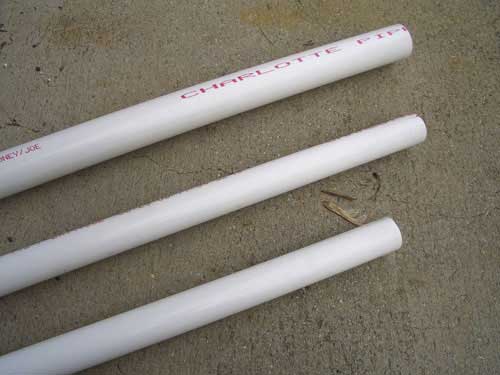
  • use pvc pipe to represent the "stack" and ping pong balls as items
  • use to make a stack, with two arrows (push, pop)
  • push a 1 to the stack, pop a 1 from the stack
  • can teach FIFO, LIFO, peak(), isempty()
  • can talk about what we can do with a stack - how do I reverse the number? push numbers and pop until empty.
  • must have rules; have "enqueue" and "dequeue" on each end
If they can hold it in their hands, they can learn it better.
  • can also use this to represent a queue
  • clear plastic tubes: can see what's inside; or using the pvc pipes it is a "black box"
PVC pipes and connectors - binary trees


- add velcro to the items (laminated pieces of paper - eg. numbers)
- data structure is recursive - "mimics itself in other places"


Use whiteboard to "code" on the board. Formulate the rules of writing an algorithm.
Allow students to generate the code or algorithm.

What other ideas - using toys to teach computing concepts?
- toy trains for linked list
- my first barrel of monkeys - linked list & pointers
- quercetti toys - binary arithmetic, good for just in the classroom
- bags of candy - separate by attribute, use to teach classes
- PB&J - logic & syntax errors
- yarn of string to teach recursion - through it across the room to students
- mancala: recursion, iteration, mathematical thinking

0 AP CS: Past, Present & Future Directions

Chris Stephenson, CSTA
www.csta.acm.org

Why a New AP CS course?
  • AP enrollment has stayed stagnant over the last ten years
  • Compared to other AP disciplines, the female participation is PITIFUL
  • African Americans - Enrollment: 17%, APCS exams 3%
We need a more engaging course
  • In many states APCS is the only CS course that counts for "anything"
  • This isn't just an equity issue, it is a survival issue
  • We are failing to engage young women and minority students
  • Students are concerned that the APCS class will take their GPA's down
  • AP CS is a "gatekeeper" course; perceived to be more difficult than other AP classes
  • Designed as a college level course
  • Never meant to be the first CS course a student ever takes
  • Sets the students up for failure and convinces them CS is not the field for them
Systemic issues
  • - unless we increase the number of students taking hs cs, our enrollments will languish at the post-secondary level
  • because CS is an elective and not a core course
  • - states are increasing the number of math and science credits students must have in order to graduate
Need to prove that CS is relevant
  • establish that CS is a science and not a technology
  • need to make what we teach connect with kids today
  • need a sensible, age level appropriate series of courses that students can take and that colleges can depend upon to be consistent and rigorous

Background
  1. last year the college board announced they were eliminating the AP CS AB exam, leaving only the AP CS A exam
  2. the AP CS A exam will continued to be reviewed and updated based on these changes and previous issues
Current Players
- AP CS Development Committee: review content and specifications, make suggestios for research studies
- AP CS Development Commission: writing the new AP CS principles course
- Chis Stephenson & Rich Lamb is on this committee (CS Dev Commission); "want a language neutral course"
- AP CS Advisory Committee: advising the commission on the big ideas of the new AP CS Principles course, advising regarding the supporting concepts; providing key feedback


Where is the Commission now
  • developed and revised big ideas
  • developed and revised key concepts
  • developed and revised supporting concepts
  • revising skills and practices document


The big ideas (shshhh!)

  • Computing is a creative human activity.
  • Abstraction is the process of reducing information and details to solve problems.
  • Humans use computer programs to manipulate data
  • Algorithms are tools for developing and expressing solutions to computational problems
  • Programming is a tool for computational problem solving and the exploration and creation of knowledge
  • Computer systems and networks facilitate communication and computational problem solving
Jan Cuny (NSF) - Making HS CS work for all students
BPC - Broadening Participation in Computing


Why high school?
1. We need to do much better there.
2. We need to start at high school to do much better elsewhere (eg. college, workplace)

Only 1% of students show up at college stating they want to study computer science
The number of degrees awarded is about equal to the number of students who enter

Why focus on AP?
- Only course that carries college credit?
- Attractive to students & schools
- 2,000 CollegeBoard audited teachers
- Single point of national leverage


2007 Stats about AP CS test takers
14,529 took AP CS A
~204,000 Calc AB
141,321 Bio
96,282 Stats

AP CS had the worst gender balance of any of the AP test
18% CS A
48.7 Calculus
50.2% Statistics

What's wrong with the current AP course?
  • doesn't appeal to many students
  • inaccessible

Math and Science in US High Schools (NRC< 2002)

AP courses should
- reflect what we know about how students learn
- build students' transferabl, conceptual understanding and inquiry skills
- convey the content and unifying themes

New AP CS course (Gold Standard Course - GSC)
  • engaging, inspiring, rigorous
  • focused on the fundamental concepts of computing
  • target for 9-12
  • pilot at the college level 2010
  • pilot at the high school level 2011
  • test available 2015
HS Computing Curriculum (course sequence)
- Intro Computing (for everyone)
- GSC
- AP CS A (possibly modified)

Goal: have the new curriculum taught in 10,000 schools by 10,000 well prepared teachers by 2015.
CS/10,000 Project

- Curriculum development
- Teacher preparation
* in-service preparation
* pre-service preparation
* ongoing professional development
* entree into schools

Where is CS in STEM? Everywhere!

The time is right. Get OUR foot in the door. There is a lot of talk about STEM education. Be aggressive. "We are not going to have this option again in 5 years."

(Short) Discussion

  1. Why was AP CS AB canceled? Not enough students taking the exam.
Another great session!

0 Grace Hopper Conference and K12 Teachers workshop


Arrived in Tucson, AZ yesterday afternoon for the Grace Hopper Conference. They are also sponsoring a K12 Teachers Workshop that began yesterday (Friday) evening with an entire day of workshops on Saturday. I am looking forward to meeting other computing teachers, sharing best practices and learning about the plethora of classes that K12 teachers are offering in computer science.

There were 650 applications to attend this workshop (full funding + stipend) and they only chose 100 of us! So it is a great privilege to attend this workshop with my colleagues. Look forward to my posts about the different sessions I attend.

Saturday, March 21, 2009

0 Is CS Education ...Engineering Education??

So if you haven't realized yet, I have an interest in the teaching and learning of computer (and information) science. My interest are diverse and include tools to teach (ie. educational technology, ITS), pedagogy, culturally relevant curriculum and issues surrounding recruitment and diversity.

I'm in the process of deciding where to go for a PhD program and it came to my attention that most people doing CS Education research are not in Engineering Education departments. Is this because most people don't consider CS and Engineering discipline? Is an Engineering Education department the place for someone interested in Computer Science education? Most people doing CS Ed research are in CS departments.

These are some of my thoughts:
  • In ENGE you gain the background/experience in education
  • You have an entire academic community/network, whereas in a CS Department you will usually only have a group/lab of several students and faculty members
  • With a degree in CS (with a CS Ed focus) you can (easily) obtain employment in CS or ENGE, whereas the opposite may not be as easy. Of course, it would depend on your experience.
  • It seems as though Computer Engineers are underrepresented in ENGE departments, so computing (educ.) research is not as prevalent. (Whats the deal with all the MechE's?? :)
My final thought is that it depends on what area of CS Ed a person is interested in....

Will sign on later with more thoughts...